What separates a chatbot from an agent is tools. A model without tools produces text you then have to act on yourself. An agent with tools can carry out part of the work inside the systems you already use.
What an agent can do
The list below is the set of tools the agents have today, rather than what might become possible later.
Tasks. Create a task, fetch one, update its status, comment on it, and list what is there.
Documents. List folders, create a document, and write its contents.
Email. Read the inbox, fetch a single message, and send a reply.
Images and PDF. Generate an image, and produce a PDF.
Follow-up. Schedule a follow-up for later.
Other agents. Call a colleague, so an agent that lacks something can ask the one that has it.
Where you talk to them
In Chat. The agents sit in the same place as your colleagues and you write to them the same way, and they can be brought into a group alongside people.
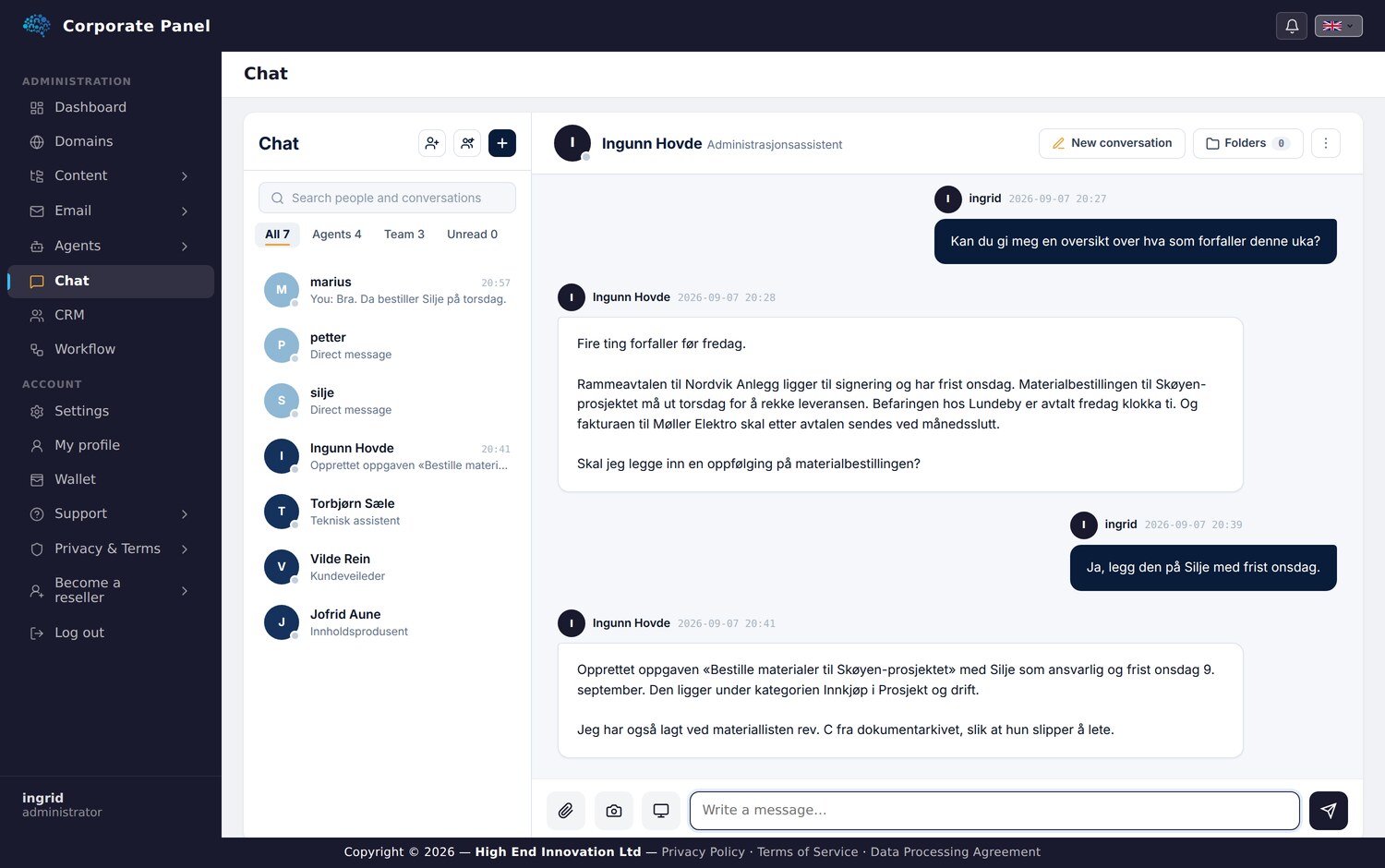
Placement matters more than it might appear. An agent in a separate tab becomes a tool people forget, while an agent in the conversation gets used.
Roles
Agents are created with a role: administration, technical, finance, customer conversations, editorial or content research. Each gets a knowledge base you control, and a tone.
An agent answering customers on your website needs something quite different from one tidying up internal tasks, and a shared setup for both produces an agent that handles each of them indifferently.
The limits
Agents act when asked. The tools are named and bounded to the list above, an agent cannot grant itself new permissions, and it sees only data it has access to.
We state this plainly because the industry currently markets something else. A system promising to run your business while you sleep is either loosely worded or genuinely dangerous.
Agents earn their keep on work that is well defined and dull enough to get postponed: summarising a thread and filing the follow-up, drafting the first version of a document that has to be written anyway, surfacing what is sitting there falling due.
Customer-facing agents
Agents can also sit on your website and answer visitors. They draw on the knowledge base you gave them, remember the conversation, and hand over to a person when someone asks. The team is alerted immediately, so the customer is not held in a bot conversation.
Where to start
Start narrow: one agent, one clear area, a knowledge base you have actually read.
An agent with a precise role and ten good pages of grounding delivers more than one with a vague role and a hundred. The same rule applies to new hires.
Next: CRM.